What does artificial intelligence actually mean?
Before we talk about AI applications in production, it's worth taking a look at the basics.
The term “artificial intelligence” is frequently used but rarely explained precisely.
Definition of artificial intelligence
Artificial intelligence refers to systems that are able to learn from data, recognize patterns and derive recommendations for action. Algorithms form the basis for this.
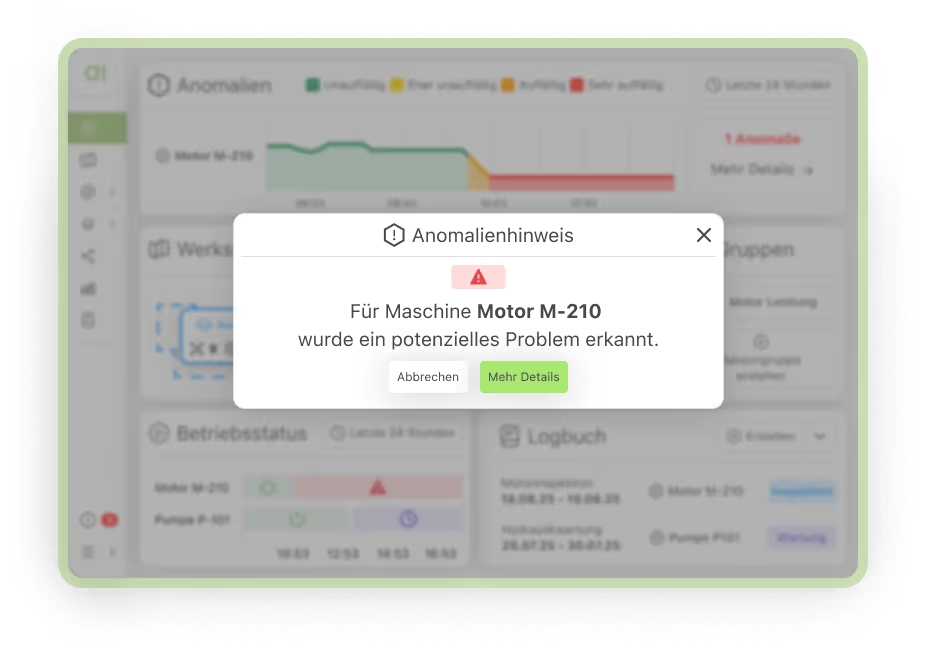
In the context of AI in industrial production, this means that machine and process data is continuously evaluated in order to identify optimizations or deviations at an early stage.
For example, an algorithm can identify deviations in vibration behavior.
Machine Learning (ML): Learning from data instead of fixed rules
Machine learning is a sub-term of artificial intelligence. Instead of predefined threshold values, the system itself learns what is “normal” and automatically detects deviations.
In industrial practice, this means:
Machines are developing a digital “behavior profile”
Production processes are modeled based on data
Unusual patterns are automatically recognized
Deep learning: neural networks for complex patterns
Deep learning is an evolution of machine learning and uses multi-layered neural networks. They can recognize highly complex patterns — for example in image data or large sensor data sets.
Typical areas of application of AI in industrial production with deep learning:
Pattern recognition in high-frequency sensor data
Optimizing complex production processes
Deep learning plays an important role in automated quality control, especially in artificial intelligence production.
Natural language processing (NLP): When machines understand language
NLP enables machines to process and interpret speech. In production, this can be used for:
Automatic analysis of maintenance logs
Digital assistance systems
Chat-based support systems
Even though NLP is less visible than condition monitoring or predictive maintenance, it is an important part of modern AI applications in production.