Options for integrating our software

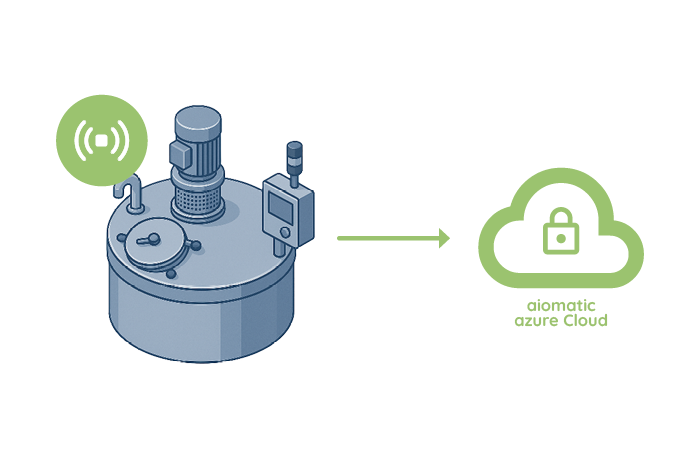
Our cloud solution stands out thanks to its straightforward integration. It connects seamlessly with existing systems, enabling access to real-time data from multiple locations, and eliminating the need for complex IT projects or hardware investments. You can get started right away – securely and scalable.
easy integration of aiomatic software

The strengths of our software in system integration

Icon goal

Implemented in
a few days

without complex IT projects
and easy scalability for additional facilities
Icon seamless integration

Seamless integration into your technical infrastructure

Our cloud solution supports various digital interfaces (e.g. OPC UA) without the need for additional hardware.
Icon high security

Highest
security standards

Your data is stored in the ISO/IEC 27001-certified Microsoft Azure cloud and managed in accordance with the GDPR and the EU AI Act.
Your machine data - our software

Data connection options

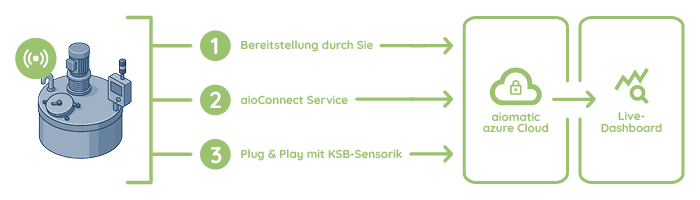
Option 1:

Provision by you

You send your data to our cloud directly via MQTT in a predefined format.

Option 2:

aioConnect Service

aiomatic provides installation instructions and manages the data connection from a standard interface (e.g., OPC UA) to our cloud.

Option 3:

Plug & Play with KSB sensors

KSB sensors capture measurement data directly from your machine and transmit it wirelessly via a gateway and the KSB Cloud to the aiomatic Cloud.

Success factors for a quick & successful project start

To ensure a smooth and rapid implementation of our solution and to maximise the project's added value, we recommend adhering to the following basic principles:
Machine data is already being digitally recorded on a periodic or event-driven basis at least once an hour.
Machine data can be made available continuously via a digital interface.
IT staff from your team are available for the implementation.

Efficient onboarding with minimal effort

1
Joint
kick-off
Time: approx. 2 hours
2
Setup planning
with our team
Time: approx. 1 hour
3
Sensor installation
by KSB
Time: approx. 1 working day
No customer effort
4
Further coordination with aiomatic
Time: 2 x 1.5 hours
Ready to use in just a few days
No complex IT project
Minimal effort on customer side
Only 6 hours of customer effort to monitor 20 use cases.
SSE logo

Potential Analysis: Is your data suitable for predictive maintenance?

Missing or inaccurate measurement series lead to errors.
That is why we automatically check your data for quality before the start of the project and thus avoid prediction errors.
Examples of challenges:
Constant measurement values despite dynamic processes
Incomplete or incorrect records
Too low data resolution for valid analyses
Benefits of our analysis:
High model quality through early detection of deficient data
User-oriented data analysis - expectation vs. reality
Uncover data-independent technical errors
Employee Luca
"Those who integrate data intelligently with AI services lay the foundations for better decision-making,
automated analysis and new digital opportunities."
Luca Jedelhauser
Technical Project Manager

Frequently asked questions

Here you will find answers to the most frequently asked questions about the implementation of our software.
aiomatic processes structured machine data such as numerical sensor values, binary signals, and categorical variables. This includes, for example, temperature, pressure, rotational speed, vibration, on/off states, operating modes, or product variants. In addition, event data such as malfunctions, maintenance records, or alarms can help classify a machine's status even more reliably.

Free text, images, videos, or audio data are not the typical core input for the software. While they may provide supplementary information in individual cases, they are not the focus of automated machine data analysis. The most important factor is that the data is available regularly, can be clearly assigned, and maintains a consistent meaning.
To get started, you either need the ability to send data directly to a broker via MQTT or, if our aioConnect solution is used, a permanently available Linux environment, usually in the form of a virtual machine.
This environment must be connected to a data interface on the network side, such as OPC UA. Once aioConnect is installed, the data is automatically processed and transmitted.
Alternatively, additional hardware can be installed that automatically transmits the data via LTE after installation.
All variants use certificate-based encryption methods to enable secure transmission.
To run our data connection client, a Linux VM is required that is permanently available and has internet access.Internally, the VM needs access to the data source, such as an OPC UA server, and then transmits the data to aiomatic via an encrypted outbound connection. The corresponding network and firewall approvals must be set up for this.
For aioConnect, data is provided via OPC UA by default. For direct MQTT data connections, structured JSON messages are used. It is important that the data is transmitted with both a timestamp and the measured values. Only current and valid readings should be transmitted to ensure reliable analysis.
The most important factor is how sensor data is made available in your environment. It matters whether the data is provided via a gateway, a box, a PLC, a SCADA system, a historian, or an IoT platform. Our standard approach is to read data at the source where it is already collected or offered, typically via an OPC UA server. Alternatively, depending on your specific setup, interfaces such as MQTT, REST, or Modbus TCP can also be used. It is essential that the relevant data points are structured, up-to-date, and clearly interpretable.