Sign up for free and test all features of our software.
Great, that worked!
Unfortunately, that didn't work out. Please check that all mandatory fields have been completed.
Predictive Maintenance for agitators
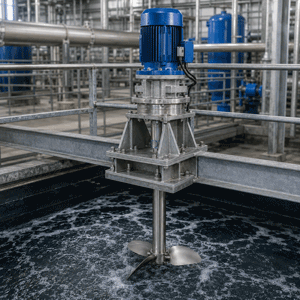
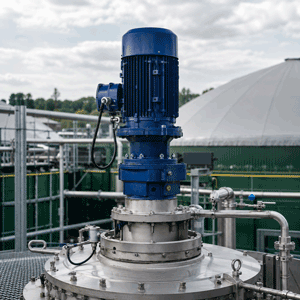
Agitators are key components in the process industry: They ensure homogeneity and control mixing and reaction processes.
With Predictive Maintenance, typical problems with agitators are detected early, before quality problems, consequential damage or unplanned downtimes occur.
These industries benefit from agitator AI-monitoring
Food & beverage industry
Water treatment
Bioenergy & environmental technology
Pharmaceutical & cosmetics industry
Paper & pulp industry
Chemical industry
Case study: agitators in the food industry
Food manufacturers often produce cereals in 3-shift operation.
Food manufacturers often produce cereals in a three-shift operation.
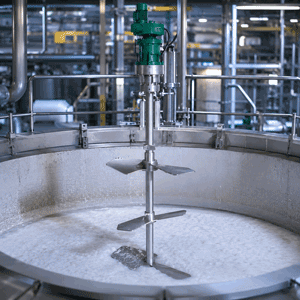
Before packaging, the products are coated, for example with syrup, depending on the variety. For this purpose, the syrup is prepared in a heated mixing tank and kept homogeneous with an agitator before it goes into the coating process.
Early detection of anomalies to prevent unplanned downtime:
Shaft misalignment due to typical vibration patterns
Imbalance due to deposits
Incipient bearing damage due to rising vibrations and temperature
Damage at the agitator due to increased vibration and higher power consumption
Increased resistance due to rising values of e.g. motor current, torque, and temperature
How do companies benefit from predictive maintenance?
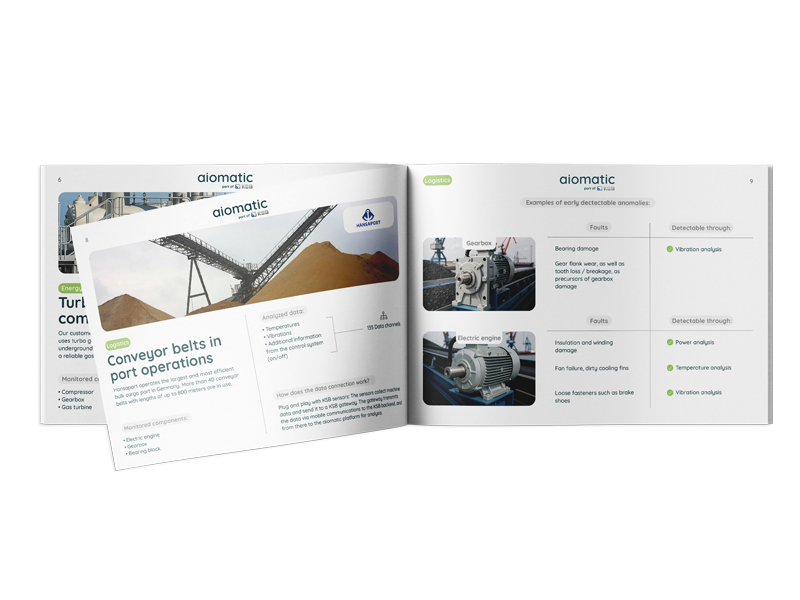
Using specific customer examples, our use case portfolio shows you how predictive maintenance makes the industry more successful, efficient and future-proof.
Unfortunately, that didn't work out. Please check that all mandatory fields have been completed.
AI in a production context instead of rigid threshold values
Detection of different recipes and operating states
Implemented in just a few days without complex IT project
Easy scalability to additional assets
Manufacturer- independent and flexible to use
Suitable for standalone machines and complex production lines
FAQ: Predictive maintenance for gitators
Can predictive maintenance detect deposits or fouling on the agitator?
Yes. Adhesions/deposits typically create imbalance and thus alter the vibration behavior. Often, a changed power consumption (motor current/kW) is also observed at the same rotational speed. In combination with contextual signals (e.g., rotational speed, recipe/batch, fill level/process parameters), such changes can be classified much more reliably.
What happens if the agitator operates in different operating states (e.g., various rotational speeds)?
This is normal for agitators. The system learns the expected sensor values for various operating states (e.g., rotational speeds). This ensures that anomaly detection remains stable even with changes in load and recipes.
Which sensors are necessary for monitoring an agitator?
For a sensible start, only a few signals are usually needed: 1. Vibration sensors (accelerometers) on the bearing housing, motor / gearbox 2. Temperature sensors (e.g., at the bearing, motor, or gearbox) 3. Signal for the power consumption of the drive (motor current or power).
Rotational speed is also a very helpful contextual parameter. Depending on the application, process signals (e.g., fill level, pressure, recipe temperature) can further improve the classification.
How does aiomatic distinguish "normal stirring" from a defect under fluctuating process conditions?
The normal behavior of agitators varies significantly. Therefore, the AI evaluates vibrations not in isolation, but within the operating context: A normal state is learned for different operating ranges and used as a reference. This allows process-related changes to be better distinguished from actual defects (e.g., misalignment, increasing imbalance).
What are the benefits of predictive maintenance for agitators (ROI)?
Typical ROI effects of predictive maintenance for agitators include fewer unplanned downtimes and lower repair and consequential costs (e.g., for bearings, gearboxes, or seals). Additionally, early detection of process deviations helps reduce scrap and maintain stable product quality. Another lever is more efficient resource utilization: maintenance and component replacement are condition-based instead of interval-based.
What is the effort required to implement predictive maintenance for agitators (installation, commissioning, operation)?
The implementation effort is low because aiomatic uses standardized and efficient onboarding, and the sensors can be easily mounted on the relevant components.
Not sure where to start?
In our free machine and use case analysis, we evaluate your potential for implementing Predictive Maintenance.