AI-powered machine monitoring

AI-powered predictive maintenance software

Predictive maintenance means continuously evaluating the condition of your machines using sensor and operational data, allowing you to schedule maintenance exactly when a defect is imminent — rather than relying on fixed intervals or waiting for a breakdown.

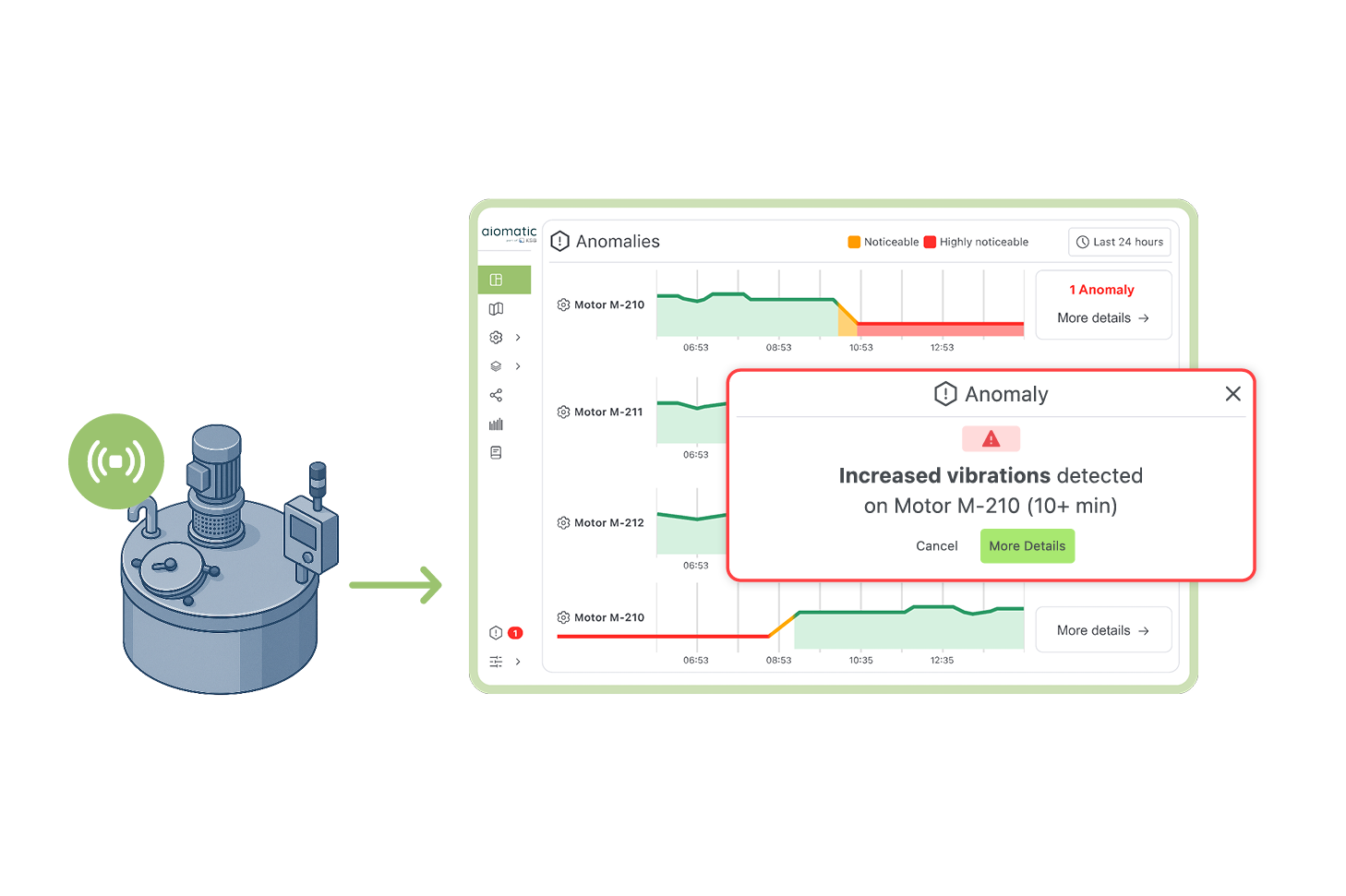
Our AI-powered predictive maintenance software detects anomalies in machine behavior early on, provides clear notifications, and gives your team the time to act before your machine stands still.
Engineer monitors Predictive Maintenance Software Dashboard
Icon for cost saving
Cost savings
Reduce maintenance costs & extend machine life
Icon for Relief and safety
Relief & safety
Real-time insights without maintenance staff
Icon for easy integration
Easy integration
Seamless integration into
existing systems
Icon for Scalability
Scalability
Algorithm expandable on other machines

Typical industry challenges

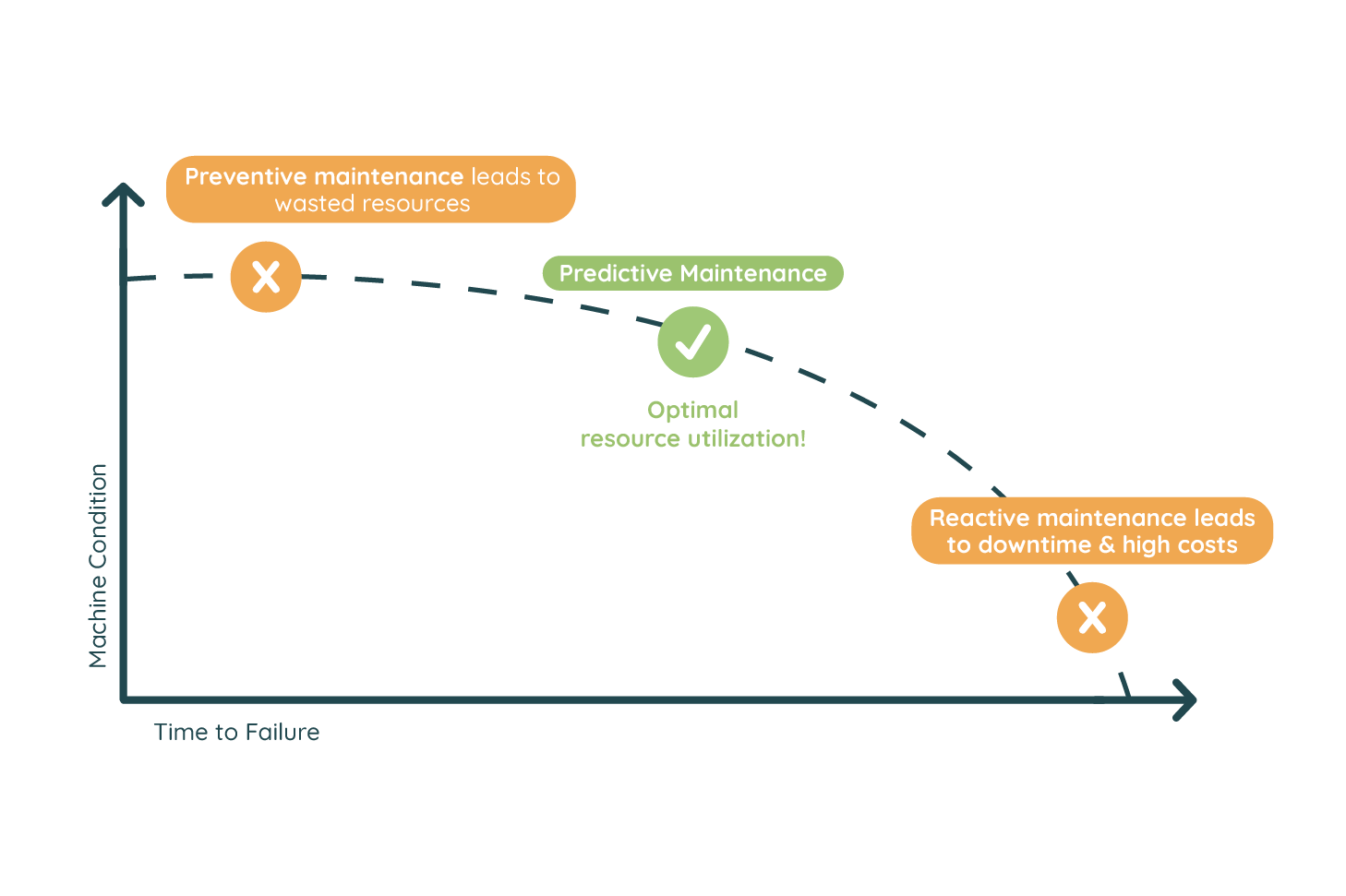
Machine maintenance is a major challenge for companies, especially when undetected anomalies suddenly lead to production downtime and delivery delays. Reactive maintenance, where repairs or replacements are only carried out after a failure, results in unplanned downtime, long outages and maintenance staff shortages. Preventive maintenance at fixed intervals is no solution either: Components that are still functioning perfectly are often replaced, resulting in avoidable costs. Even conventional condition monitoring has its limitations: Deviations are only reported once a threshold has already been exceeded.

Predictive maintenance takes a more proactive approach: Early signs of anomalies are detected by analysing the interplay of multiple data points and the production context. The moment measured values deviate from the baseline, our AI sends notifications.
Comparison of reactive, preventive, and predictive maintenance
Timing
Data basis
Drawbacks
Reactive
After failure
Fault data
Unplanned downtime,
high costs
Preventive
Fixed intervals
Empirical values,
manufacturer specifications
Maintenance often too early or too late, high costs and personnel
Condition-based
When a defined
threshold is exceeded
Sensor and
condition data
Fixed thresholds cannot
map complex states
Before the predicted failure,
at the optimal time
Continuous machine
& process data + AI
Requires initial
data connection & integration

Herausforderungen der Industrie bei der Wartung

Die Wartung von Maschinen ist eine große Herausforderung für Unternehmen – besonders, wenn unerkannte Störungen plötzlich zu Produktionsfehlern und Lieferverzögerungen führen. Reaktive Wartung durch Reparaturen oder den Austausch von Komponenten führt zu ungeplantem Maschinenstillstand, langen Ausfallzeiten und Engpässen beim Wartungspersonal. Auch präventive Wartung nach festem Intervall schafft keine Abhilfe: Sie tauscht Komponenten aus, die noch einwandfrei laufen, und verursacht so vermeidbare Kosten. Selbst die zustandsbasierte Wartung stößt an ihre Grenze – sie meldet eine Abweichung erst, wenn ein Grenzwert bereits überschritten ist. Vorausschauende Instandhaltung setzt früher an: Sie erkennt die Entwicklung, die zum Anlagenausfall führt, während die Messwerte noch im Normalbereich liegen.

Vergleich von reaktiven, vorbeugenden und vorausschauenden Wartungen

Typical industry challenges

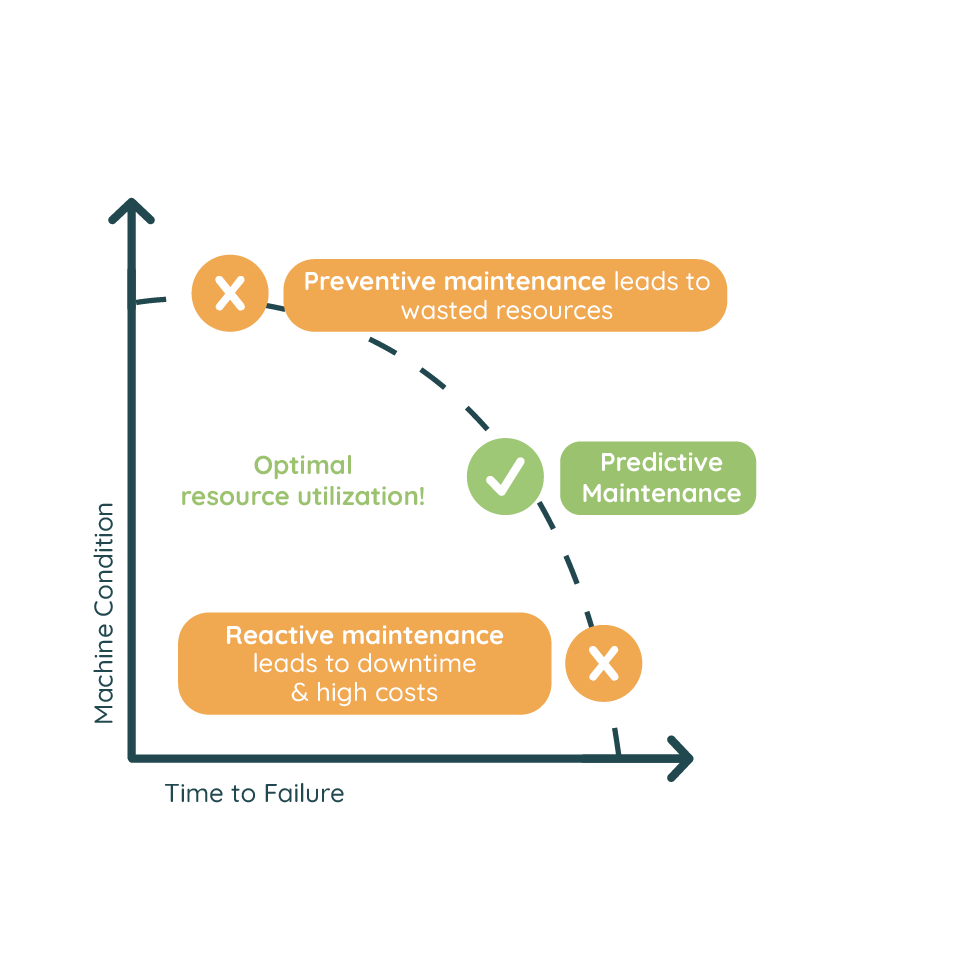
Machine maintenance is a major challenge for companies, especially when undetected anomalies suddenly lead to production downtime and delivery delays. Reactive maintenance, where repairs or replacements are only carried out after a failure, results in unplanned downtime, long outages and maintenance staff shortages. Preventive maintenance at fixed intervals is no solution either: Components that are still functioning perfectly are often replaced, resulting in avoidable costs. Even conventional condition monitoring has its limitations: Deviations are only reported once a threshold has already been exceeded.

Predictive maintenance takes a more proactive approach: Early signs of anomalies are detected by analysing the interplay of multiple data points and the production context. The moment measured values deviate from the baseline, our AI sends notifications.
Vergleich von reaktiven, vorbeugenden und vorausschauenden Wartungen

Benefits of Predictive Maintenance

Our predictive maintenance software is a real-time check for your machinery. Using artificial intelligence and data analytics, the maintenance software identifies early signs of potential anomalies and downtimes. This allows you to plan maintenance strategically, minimize downtime, and sustainably reduce maintenance costs. According to current market analysis by McKinsey & Company (2024–2026), predictive maintenance offers significant advantages:
Lower maintenance costs by 20 - 40 %
Reduce downtime up to 50 %
Increase machine availability up to 20 %
Increase labor productivity up to 25 %

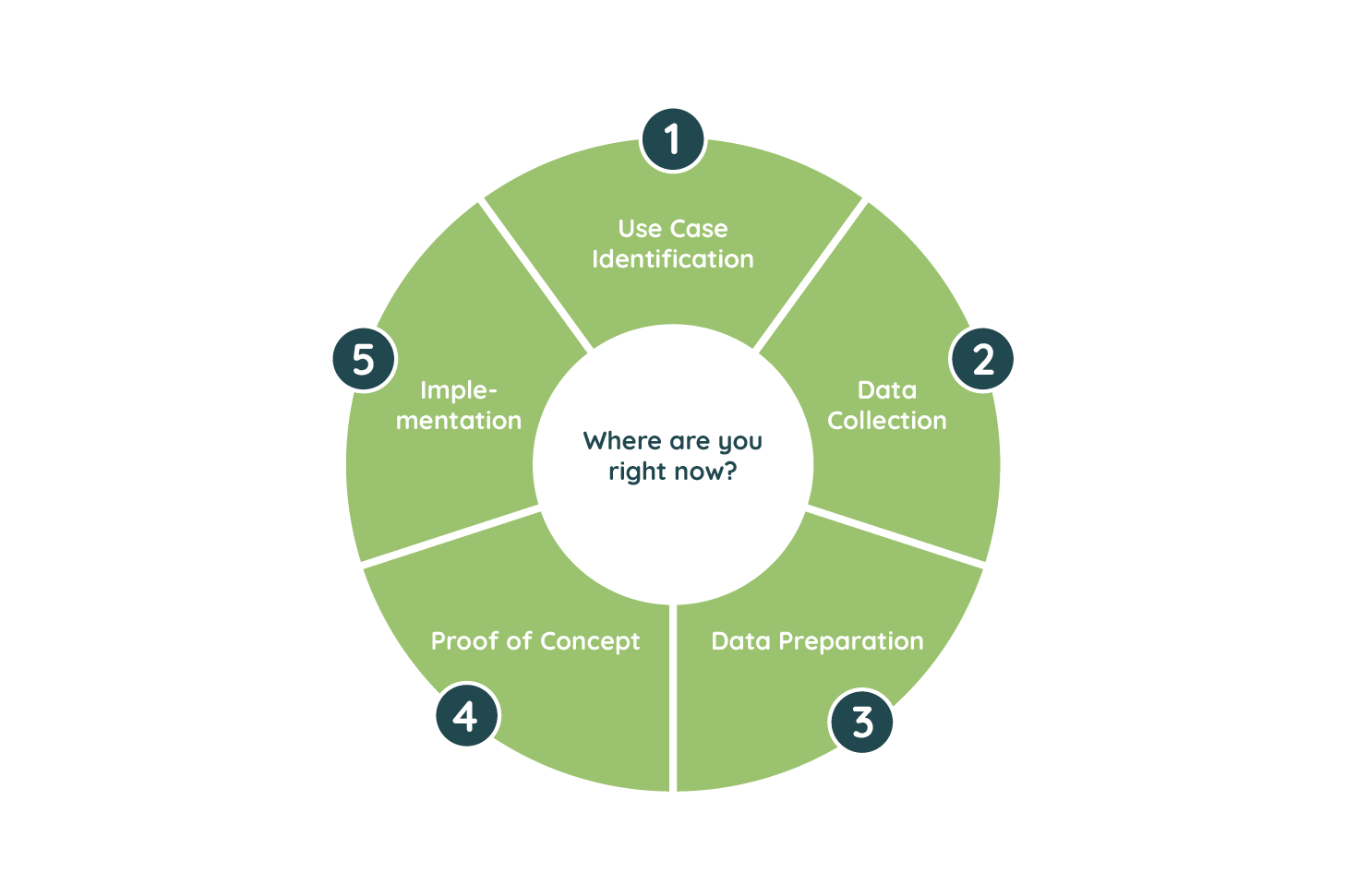
5 steps to Predictive Maintenance

From identifying the use case to implementation and continuous optimization of the maintenance plan — we help you with every step of your Predictive Maintenance project.
‍
Erklärung der fünf Schritte zu Predictive Maintenance

5 steps to predictive maintenance

From identifying the use case to implementation and continuous optimization of the maintenance plan — we help you with every step of your predictive maintenance project.
‍
Explanation of the five steps to Predictive Maintenance

Success factors for your predictive maintenance project with aiomatic

Our digital maintenance assistant detects anomalies in your machine behaviour early on and helps you to avoid unplanned downtime. To get the most value out of your project, we recommend these fundamentals:
You operate critical systems with continuous processes where downtime and consequential damage result in high costs.
You are interested in plug-and-play wireless sensor technology or can provide your machine data via interfaces such as OPC UA or MQTT.
A maintenance team works with the maintenance assistant, reviews anomaly reports and provides brief feedback to help the AI learn.

How does our AI-powered predictive maintenance solution work?

Easy connection of your machines (e.g. via OPC UA)
Retrofitting of sensors where necessary
AI learns the normal operating state from the collected data
Live monitoring: Early detection of anomalies
Data visualisation in the dashboard:
Automatic notifications in the event of unusual machine behaviour
Detailed analysis by certified KSB vibration experts
Bild vom aiomatic dashboard

Predictive Maintenance requirements

Datenstruktur Icon
High level of digitization of your machines as well as a secure and scalable data infrastructure.
Sensordaten Icon
Reliable sensor data that allows conclusions to be drawn about the status of the systems.
Icon einer Lupe
Machine data is digitally recorded periodically or on an event-based basis at least once an hour

Successful customer examples from industry

Bicycle manufacturing
Assembly lines in
bicycle manufacturing
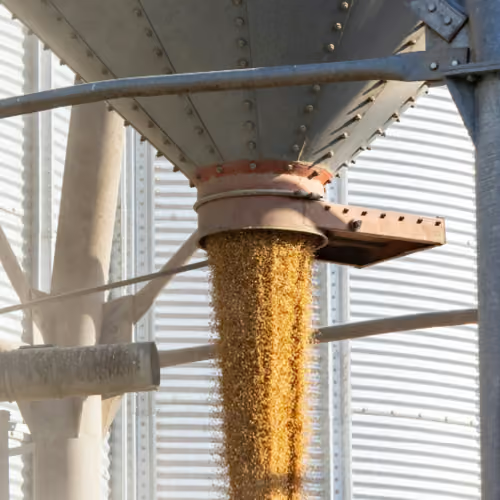
Pet food grinding machine
Grinding & extrusion
of animal feed
Conveyor belts in port operations
Conveyor belts in
port operations
Reciprocating gas compressor
Reciprocating
gas compressor
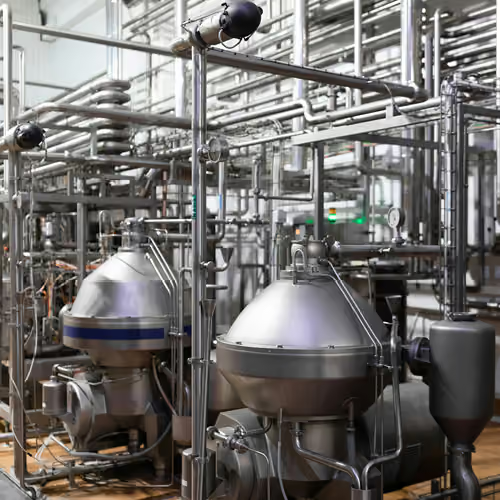
machine in food production
Mixing, roasting & cooling machine for cereals
gravure printing press
Gravure printing press for package printing
Bottling plant in the beverage industry
Beverage
bottling plant
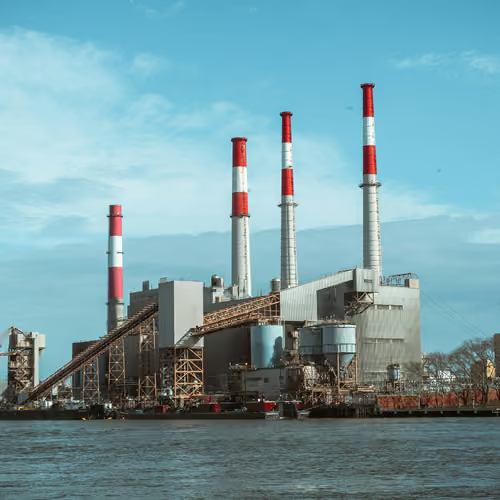
pumps in heat and power plant
Pumps of a combined
heat and power plant

How do companies benefit from predictive maintenance?

Using specific customer examples, our use case portfolio shows you how predictive maintenance makes the industry more successful, efficient and future-proof.
Unfortunately, that didn't work out. Please check that all mandatory fields have been completed.
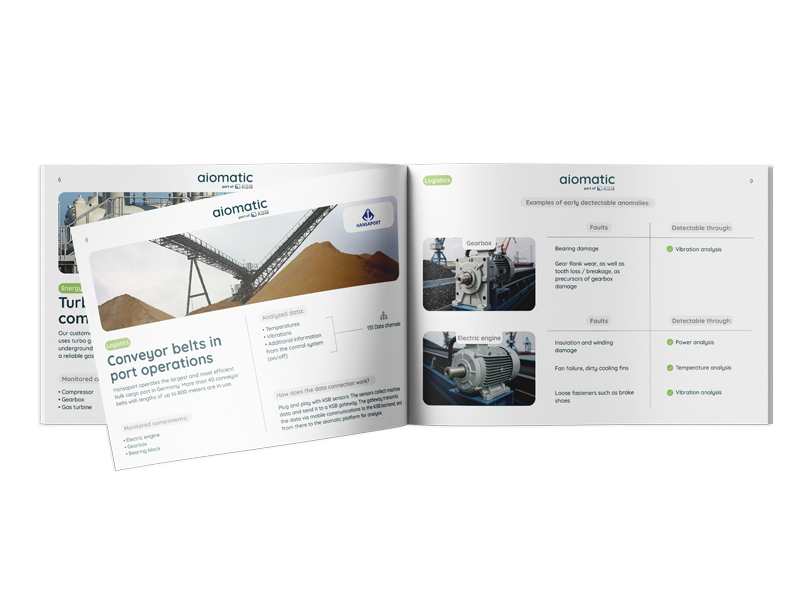
PDF preview of machine types and error types
Support

Frequently asked questions

Here you can find answers to the most common questions about predictive maintenance and our software solution.

What types of data are used for Predictive Maintenance?

Predictive Maintenance uses sensor data such as temperature, vibration, and pressure to monitor the condition of machines in real time and detect anomalies at an early stage.

Which role do the application areas of Condition Monitoring & Predictive Maintenance play?

Condition Monitoring and Predictive Maintenance play a central role in improving plant reliability. While Condition Monitoring monitors the current state of the machine, Predictive Maintenance goes one step further: With AI-based analysis, it predicts errors before they occur. Predictive Maintenance software thus reduces unplanned downtimes, extends the life of systems and lowers maintenance costs. Together, they enable more efficient planning and ensure smooth operation.

AI Predictive Maintenance: Where is AI used in our software?

Artificial intelligence is used in several places in our software:

1. Machine understanding:
AI helps to understand and meaningfully analyze the structure and functioning of systems.

2. Calculation of the Anomaly Index:
Instead of just using fixed thresholds, AI takes adaptive thresholds into account. This means that it recognizes changes in assets over time, learns from them and adjusts the assessments accordingly.

How can our Predictive Maintenance software help to reduce costs?

Predictive Maintenance software reduces costs by predicting failures, avoiding unplanned downtimes and extending the life of machines through targeted maintenance. In addition, maintenance cycles are optimized and the availability of machines is increased, which leads to better production performance.

What are the challenges of implementing Predictive Maintenance?

Challenges include the integration of various data sources, the selection and, if necessary, retrofitting of suitable sensors, the need for qualified personnel for data analysis, and the initial investment costs. The team of aiomatic experts will support you every step of the way.

How do I start implementing Predictive Maintenance in my company?

The implementation of a Predictive Maintenance project starts with an as-is analysis: Identify relevant machines and available sensor data. Then you choose a suitable software solution and run a Proof of Concept (PoC) to check the feasibility and benefits. The solution is then integrated into your processes, accompanied by training for your team.
Thank you We have received your message and will get back to you as soon as possible!
Unfortunately that didn't work! Please check that all mandatory fields have been filled out!